SAN2. Rethinking Comparison
Lecture 4: Frontal and lateral
(handout)Matei Candea
[email protected]
© 2026 Matei Candea — CC BY 4.0 (except third-party images (see final slide) )
Introduction
I. Frontal comparison
'us' and 'them'
A recurring anthropological form:
- Bronislaw Malinowski (1922) on Trobriands Kula versus Western economics
- Jomo Kenyatta (1938) on Gikuyu versus British colonial understandings of land
- Ruth Benedict (1946) on Japanese honour versus American individualism
- Fei Xiaotong (1947) on Chinese versus Western modes of association
- Louis Dumont (1968) on Indian hierarchy versus European egalitarianism
- Marilyn Strathern (1987) on Melanesian dividuals and Western individuals
- Eduardo Viveiros de Castro (1998) on Amerindian perspectivism v Euroamerican naturalism
- and more generally and recently 'the ontological turn' (see Holbraad and Pedersen 2017)
Classic critiques
Colonial, exoticist, 'othering' (is this 'primitive versus modern' all over again)?
- Todd, Z. 2016. An indigenous feminist’s take on the ontological turn:‘ontology’ is just another word for colonialism. Journal of historical sociology 29, 4–22.
- Bessire, L. & D. Bond 2014. Ontological anthropology and the deferral of critique. American ethnologist 41, 440–456
- Chua, L. & N. Mathur 2018. Who are ’we’? reimagining alterity and affinity in anthropology. New York: Berghahn.
for some responses, see: Holbraad, M., M. A. Pedersen & E. Viveiros de Castro 2014. The politics of ontology: Anthropological positions. Cultural anthropology online
simplistic?
- “‘[…]We should look with suspicion on anyone who claims that there are two kinds of people, two kinds of reality or process. (Douglas 1978, 161).
“‘[t]he false “us and them” dichotomy is no more than a bad caricature” (Gingrich and Fox 2002b: 20).
The case for frontal comparison
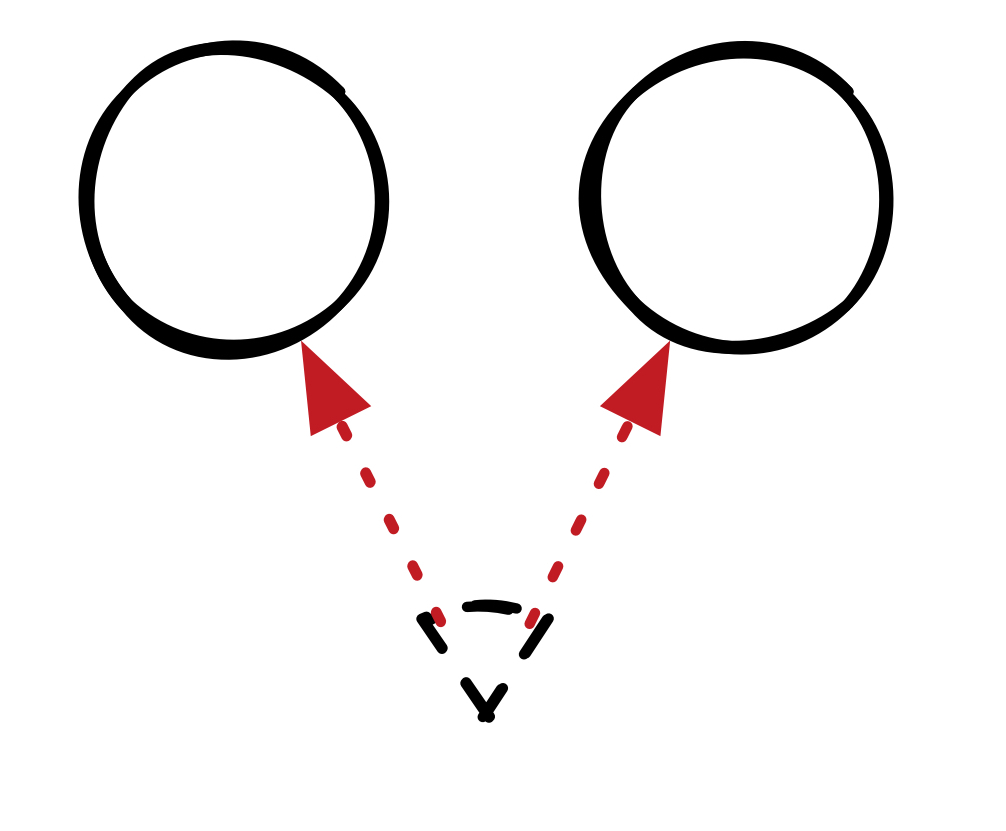
“Comparison is just double attention” (Condillac)
but who is paying attention?
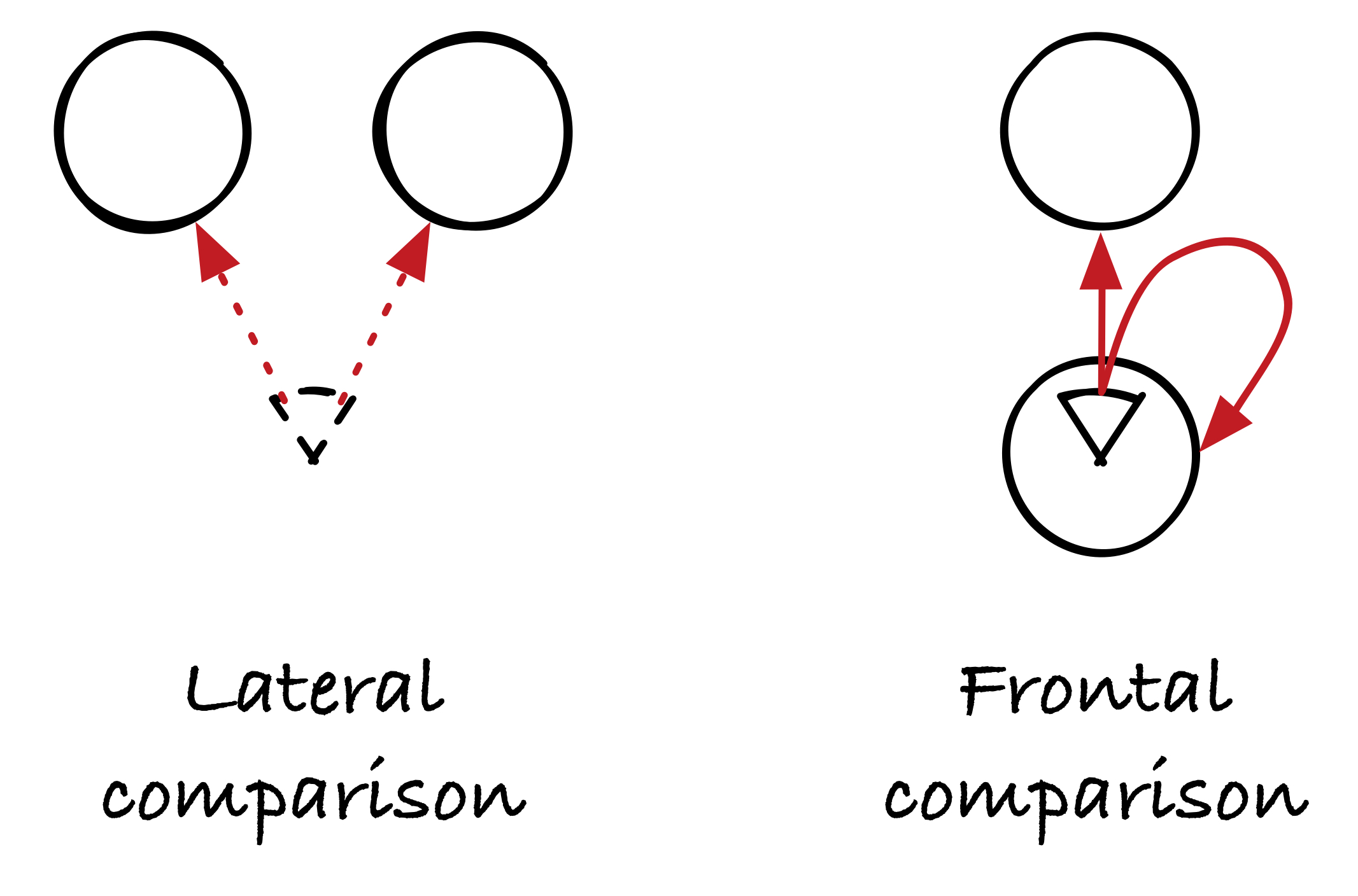
being ‘conscious of the eyes through which one looks’ (Benedict)
“Some might ironically suggest that such binary oppositions have a sort of nineteenth-century flavor, or state with Mary Douglas that ‘[…]We should look with suspicion on anyone who claims that there are two kinds of people, two kinds of reality or process. (Douglas 1978, 161). To this we shall quietly respond that there are two ways of looking at any piece of knowledge, a superficial one that leaves the knowing subject out of account, and a deeper one that includes him.” (Dumont 1986:5)
II. an example: Eduardo Viveiros De Castro on Amerindian perspectivism
The basic idea: 'controlled equivocation'
- Cashinawa - txai
- we are all brothers vs. we are all brothers-in-law
- refusing to reduce the world of 'others' to another version of the familiar
- instead challenging liberal Euro-American assumptions about nature, kinship and humanity
a more detailed example: Amerindian perspectivism
Viveiros de Castro, E. 1998. 'Cosmological Deixis and Amerindian Perspectivism'. Journal of the Royal Anthropological Institute, 4(3), 469-488.
- ethnographic themes across amazonia:
- jaguars are persons, live in villages, drink beer, eat peccary
- transformations: shamanism, capture
from the human's point of view
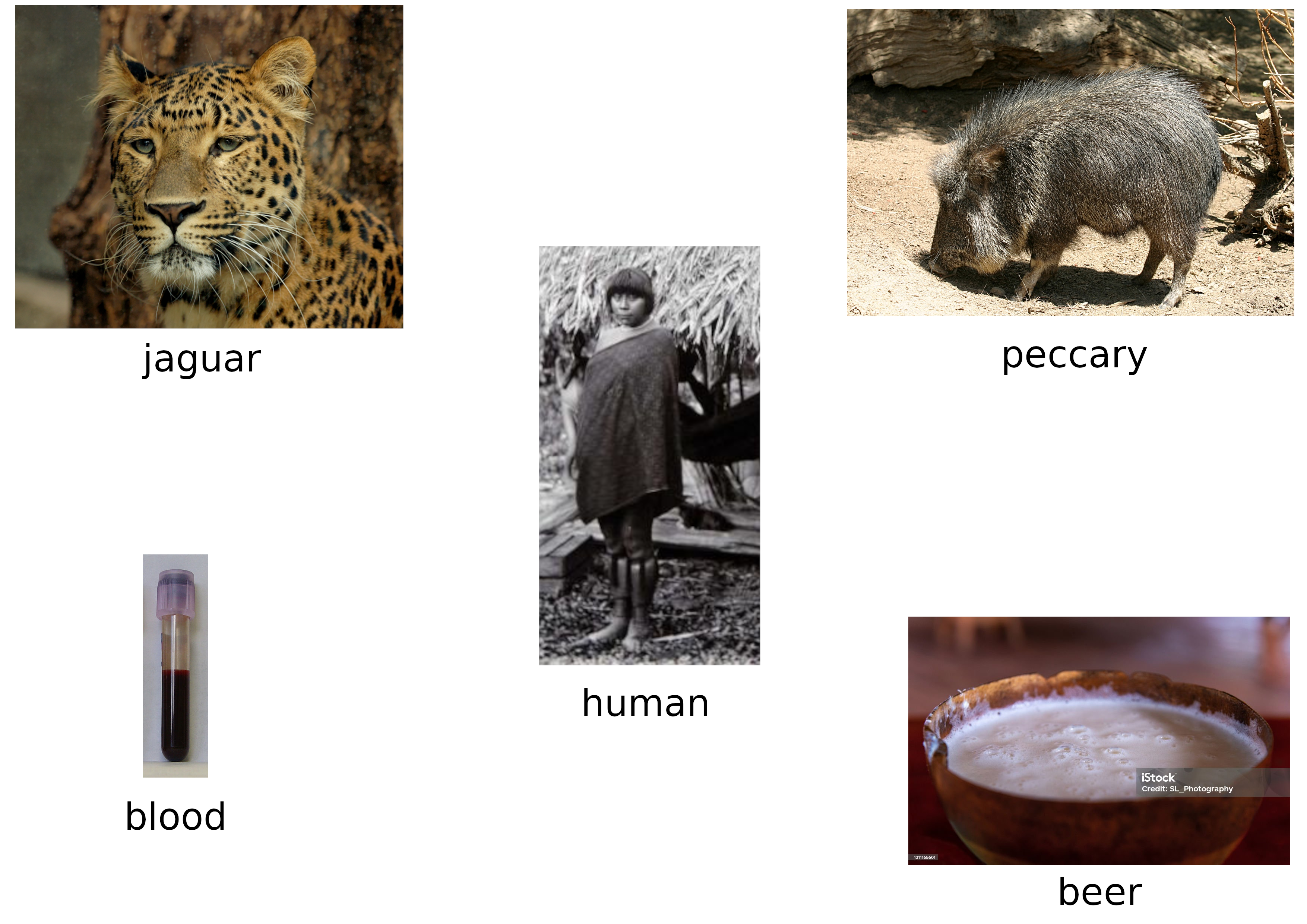
from the jaguar's point of view
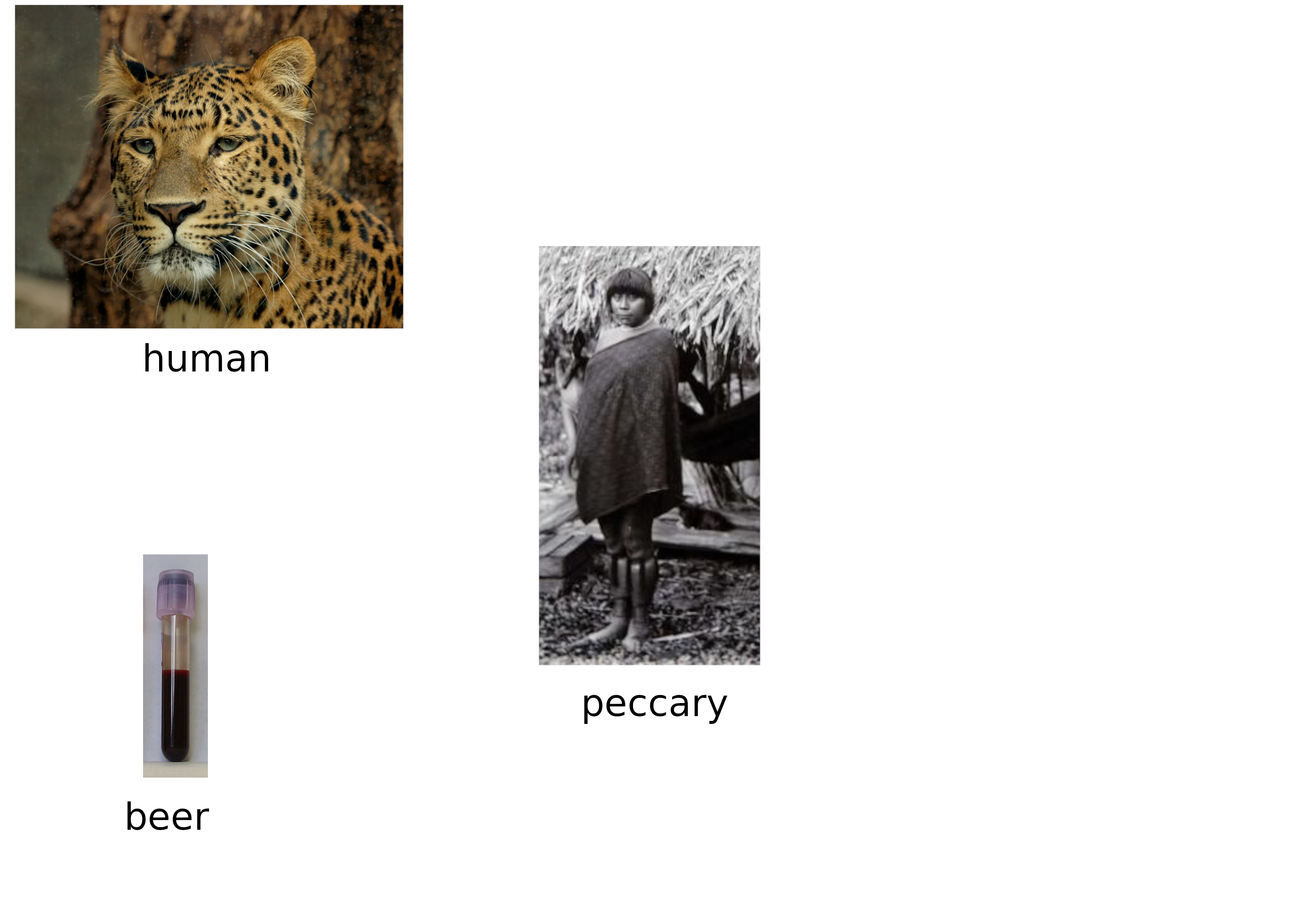
Euroamerican naturalism: one nature, many cultures
Amerindian perspectivism: one culture, many natures
| what is universal, stable, shared? | what is relative, different, shifting? | |
| Euroamerican naturalism | nature, bodies, objects | culture, minds, perspectives |
| Amerindian perspectivism | culture, minds, perspective | nature, bodies, objects |
Here's the kicker:
- this is not just 'their cultural ideas'
- the whole idea of 'cultural difference' is our naturalist idea
- we need to take seriously a radical challenge to the nature/culture distinction
- and thus to anthropology itself
the broader project
- this kind of analysis ‘has little to do with trying to determine how other people think about the world. It has to do with how we must think in order to conceive a world the way they do’ (Henare, Holbraad, and Wastell 2007: 15).”
more technically: “Their ideas must be made to appear through the shapes we give to our ideas” (Strathern 1987)
cf Wittgenstein on problems v. puzzles:
Philosophical problems are “not empirical problems; they are solved, rather, by looking into the workings of our language, and that in such a way as to make us recognise those workings: in despite of an urge to misunderstand them. The problems are solved, not by giving new information, but by arranging what we have always known.”
Frontal comparison dissolves 'puzzles'
This matters politically: anthropology as “the science of the ontological self-determination of the world's peoples … the permanent decolonization of thought” (Viveiros de Castro)
III. combining frontal and lateral comparison
proponents of frontal comparison say:
| bad | good | |
| lateral comparison | An objectivist ‘view from nowhere’ | |
| frontal comparison | A deployment of ethnography to challenge euroamerican and/or anthropological concepts |
critics of frontal comparison say:
| bad | good | |
| lateral comparison | A careful consideration of differences and similarities in specific cases and locations | |
| frontal comparison | An essentialist (and geographically vague) account of “us” and “them” |
"In closing this introduction I should insert a note about my own use of the concepts of ‘the Western’ and ‘the modern’. These concepts have been the source of no end of trouble for anthropologists, and I am no exception. Every time I find myself using them, I bite my lip with frustration, and wish that I could avoid it. The objections to the concepts are well known: that in most anthropological accounts, they serve as a largely implicit foil against which to contrast a ‘native point of view’; that much of the philosophical ammunition for the critique of so-called Western or modern thought comes straight out of the Western tradition itself (thus we find such figures as the young Karl Marx, Martin Heidegger and Maurice Merleau-Ponty enlisted in the enterprise of showing how the understandings of North American Indians, New Guinea Highlanders or Australian Aborigines differ from those of ‘Euro-Americans’); that once we get to know people well – even the inhabitants of nominally Western countries – not one of them turns out to be […] particularly modern in their approach to life; and that the Western tradition of thought, closely examined, is as richly various, multivocal, historically changeable and contest-riven as any other." (Ingold 200:6-7)
two contrasting heuristics combined
| bad | good | |
| lateral comparison | A deployment of ethnography to challenge euroamerican and/or anthropological concepts | |
| frontal comparison | A careful consideration of differences and similarities in specific cases and locations |
e.g.: back to Lenin's body
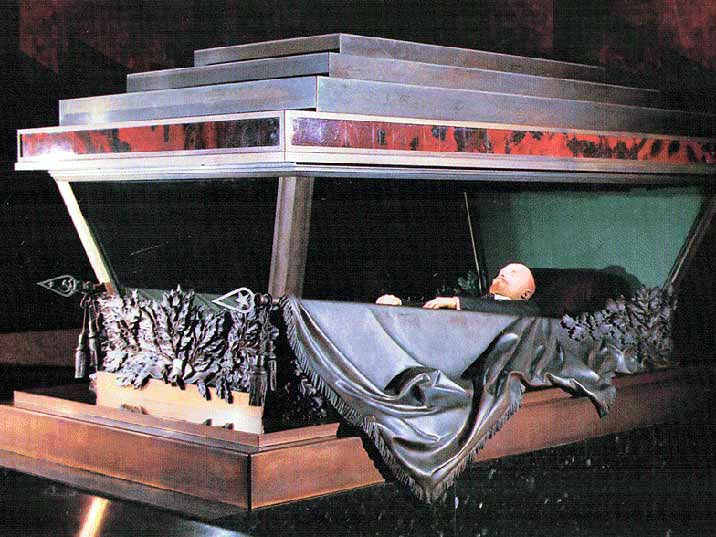
Yurchak, A. 2015. Bodies of lenin. Representations 129, 116–157. cf. SAN1 lecture 1
- an ethnographic puzzle
- lateral comparisons: lenin vs saints vs kings etc.
- frontal comparison: for 'us' authenticity is about substance, but for early soviet russians, authenticity is about form
these are entwined in every anthropological argument
| frontal | lateral |
|---|---|
| Viveiros de Castro's main argument | Viveiros de Castro's roundup of the Amazonianist literature |
| Malinowski's contrast between Kula and western economics | Malinowski's tracing of implications of kula across Trobriand politics, kinship, ritual, technology etc. |
| etc… |
and more generally…
| frontal | lateral |
|---|---|
| the main argument of a book | its various chapters |
| arrival stories | different aspects of the same social setting |
| striking ethnographic vignettes | multiple repetitive events |
Conclusion
Making comparison robust
- Lateral comparisons:
- what and who is there (communities, practices, ideas, etc.)?
- how are they different and similar, continuous and discontinuous, changing or stable?
- frontal comparisons:
- what was I assuming going in?
- what am I still assuming now?
- how might the very nature of my practice, my questions, my politics, be transformed by what my interlocutors think or do?
in sum
Comparison is not impossible: it is a bundle of heuristics:
- analogy and contrast
- connecting and distinguishing
- frontal and lateral
some parting advice
- make your comparisons thick: attend to differences and similarities
- make them interesting: attend to continuities and discontinuities
make them robust: attend to empirical facts and reflexive self-questioning
Images in order of appearance:
front-lat-art.jpg; chase-kennedy-uvmTg80KJ4o-unsplash.jpg; mick-haupt-Uu5K-7gDBds-unsplash.jpg; lat.jpg; front-lat.jpg; chuttersnap-MpxAiNDevjU-unsplash.jpg; human-POV.png; jag-POV.png; lenin-mausoleum.jpg Credit: Oleg Lastochkin/RIA Novosti/CC; comp2.jpg; nishant-jain-zqLjf0ozkrA-unsplash.jpg
All unsplash images under unsplash license. All other images, unless otherwise noted, © Matei Candea 2026 CC-BY 4.0