SAN2. Rethinking Comparison
Lecture 1: an impossible method?
(handout)Matei Candea
[email protected]
Introduction
an impossible method?
“There's only one method in social anthropology, the comparative method, and that's impossible” (Evans-Pritchard, quoted in Needham 1975:364)
And yet we compare…
Boyer, D. & A. Yurchak 2010. American stiob: Or, what late-socialist aesthetics of parody reveal about contemporary political culture in the west. Cultural anthropology 25, 179–221
Stiob
- stiob (stee-yob): late socialist ironic aesthetic
- parodic over-identification
- a response to hyper-formalisation of state socialist language
e.g. bad rock bands
- 1980s article in Leningradska Pravda critical of rock bands
- “These so-called musicians [display] complete lack of talent and very little skill in playing musical instruments. …[The] deafening noise [of their music] reveals overall helplessness, the silliness of their texts reveals banality, …their false pathos reveals social inadequacy.” Typical examples of this deprived bourgeois product are such bands as Alisa and Akvarium! “It is time,” concludes the article, “that the Communist Youth League [the Komsomol] takes a very serious look at this problem.”
- signed by the frontman of Akvarium
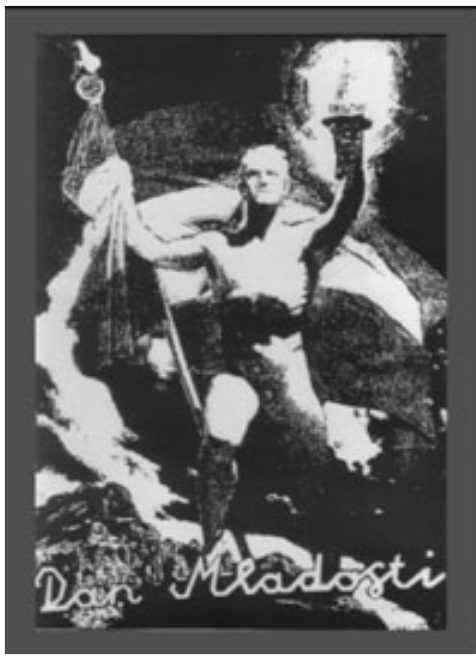
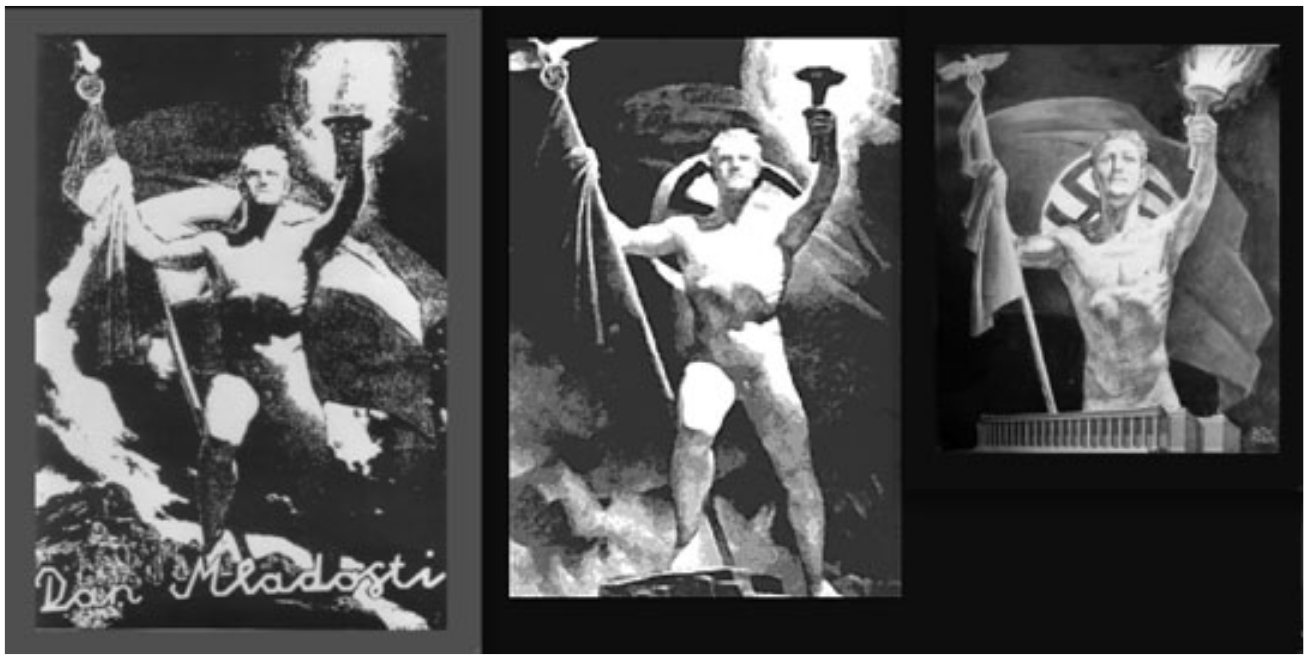
e.g. Tito's birthday
American Stiob?
- a new kind of humour in the 90s and 2000s
- “As in the late-socialist case, American stiob is typified by a parodic overidentification with the predictable and repeatable forms of authoritative discourse (incl. phraseology, rhetorical structure, visual images, performative style) in which political and social issues are represented in media and political culture."

theonion.com
- On 12th of May 2002, Kinnithrung Sprat, WTO representative, announces the dissolution of the World Trade Organisation
- “The new organization, which pending ratification will be referred to as the Trade Regulation Organization (TRO), will have as its basis the United Nations Universal Declaration of Human Rights, with the aim of ensuring that the TRO will have human rather than business interests as its bottom line. …The changes come in response to recent studies, which indicate strongly that the current free trade rules and policies have increased poverty, pollution, and inequality, and have eroded democratic principles, with a disproportionately large negative effect on the poorest countries. As of September, agreements reached under the WTO, as well as under GATS, TRIPS, and other frameworks, will be suspended pending ratification by the TRO.”
- actually a hoax by the ‘Yes Men’
- the WTO has to make an official statement denying the above
“we show how late liberalism today operates increasingly under discursive and ideological conditions similar to those of late socialism, and we argue that these conditions are contributing to the development of certain analogous political and cultural effects. Specifically, we argue that the highly monopolized and normalized conditions of discourse production that characterized the political culture of Eastern European late socialism anticipated current trends in Western media, political discourse, and public culture. We show that analogues to the ironic modalities normally associated with late socialism have recently become more intuitive and popular in places like the United States. And so, we argue that to understand contemporary late-liberal ideology and political culture in the West, deeper comparative ethnography of socialist ideology and political discourse will prove a remarkably helpful conceptual resource.” (Boyer and Yurchak, 2010, p. 181)
the comparison paradox
Comparison is alive and well in practice…
… but challenging in theory.
I. A vintage model of comparison
Evans-Pritchard, E. E. 1951. Social anthropology. London: Cohen & West.
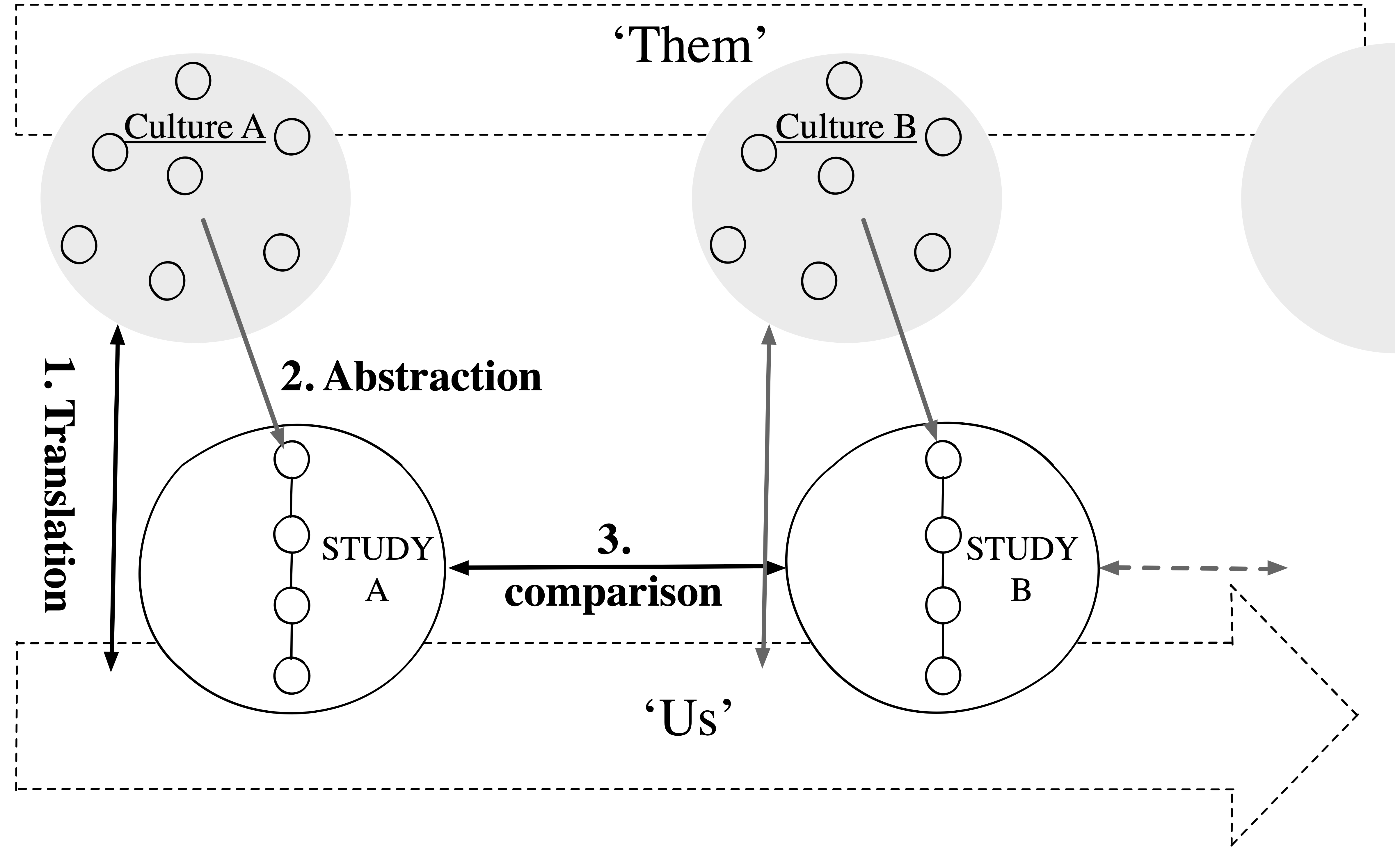
step 1: translation
The anthropologist “goes to live for some months or years among a primitive people. He lives among them as intimately as he can, he learns to speak their language, to think in their concepts and to feel in their values. He then lives his experiences over again critically and interpretively in the conceptual categories and values of his own culture and in terms of the general body of knowledge of his discipline. In other words, he translates from one culture to another." (Evans-Pritchard 1950: 121)
step 2: abstraction
“the anthropologist ‘seeks by analysis to disclose the latent underlying form of a society or culture’ […] This structure cannot be seen. It is a set of abstractions, each of which, though derived, it is true, from analysis of observed behaviour, is fundamentally an imaginative construct of the anthropologist himself. By relating these abstractions to one another logically so that they present a pattern he can see the society in its essentials and as a single whole.” (Evans-Pritchard 1950: 121)
step 3: comparison
“If he formulates these clearly and in terms which allow them to be broken down into problems of research it is then possible for the same, or another, anthropologist to make in a second society observations which will show whether these conclusions have wider validity. He will probably find that some of them hold, that some of them do not hold, and that some hold with modifications. Starting from the point reached by the first study, the second is likely to drive the investigation deeper and to add some new formulations to the confirmed conclusions of the first … A third study is now made, and then a fourth and a fifth. The process can be continued indefinitely.” (Evans-Pritchard 1950: 89-90)
we might draw E-P's model like this:
II. Three problems
the problem of translation
power/knowledge issues between anthropologists and their interlocutors
“primitive”? “his culture”?
- Spivak, G. C. 1988. Can the subaltern speak. Marxism and the interpretation of culture 271–313.
- Asad, T. 1986. The concept of cultural translation in british social anthropology. In Writing Culture: The Poetics and Politics of Ethnography (eds) J. Clifford & G. Marcus. Berkeley: University of California Press.
Povinelli, E. A. 2001. Radical worlds: The anthropology of incommensurability and inconceivability. Annual review of anthropology 319–334
whose categories?
- Chakrabarty on ‘class’
long before him, Boas on ‘murder’:
“The person who slays an enemy in revenge for wrongs done, a youth who kills his father before he gets decrepit in order to enable him to continue a vigorous life in the world to come, a father who kills his child as a sacrifice for the welfare of his people, act from such entirely different motives, that psychologically a comparison of their actions does not seem permissible.” (Boas 1911:173)
the problem of mapping
the difficulty of specifying the objects and relations of comparison
what are the units of comparison?
- Clifford, J. & G. Marcus (eds) 1986. Writing culture: The poetics and politics of ethnography. Berkeley: University of California Press.
Chua, L. & N. Mathur 2018. Who are ’we’? reimagining alterity and affinity in anthropology. New York: Berghahn.
Already in 1940…
“At the present moment of history, the network of social relations spreads over the whole world, without any absolute solution of continuity anywhere. This gives rise to a difficulty which I do not think that sociologists have really faced, the difficulty of defining what is meant by the term ‘a society.’ They do commonly talk of societies as if they were distinguishable, discrete entities, as, for example, when we are told that a society is an organism. Is the British Empire a society, or a collection of societies? Is a Chinese village a society, or is it merely a fragment of the Republic of China? If we say that our subject is the study and comparison of human societies, we ought to be able to say what are the unit entities with which we are concerned.” (Radcliffe-Brown 1940)
the problem of purpose
what's the point?
“The essential point to remember is that the anthropologist is working within a body of theoretical knowledge and that he makes his observations to solve problems which derive from it … We tell our anthropological students to study problems and not peoples.” (Evans-Pritchard 1951: 87)
Are we though?
and is comparison just for ‘us’?
‘who controls the comparison and with what end in view?’ (Lloyd 2015: 31).
from problems to impossibilities
these problems are mutually entailing
e.g. of recent debates:
- Johnson, J. 2018. Feminist anthropology and the question of gender. In Schools and Styles of anthropological theory (ed) M. Candea. London: Routledge.
- Fadil, N. & M. Fernando 2015. Rediscovering the “everyday” muslim: Notes on an anthropological divide. Hau: Journal of ethnographic theory 5, 59–88
III. A change of perspective
beyond revolution
part of the problem is ‘caesurism’ : theoretical discussions cast as a series of revolutions.
(Martins 1974, Pina-Cabral 2010, Candea Impossible method chapter 3)
a ‘caesurist’ history of comparison
- Comparative Method v. the historical method (1900s)
- Comparison v. Description (1920s)
- Empiricism v. structuralism (1950s)
- Positivism v. interpetivism (1970s)
- Realists v. pomos (1980s)
see Candea, The impossible method, chapter 2
the problem with caesurism
not impossible, just multiple
comparison as a bundle of heuristics
cf. Abbott, A. 2004. Methods of discovery: Heuristics for the social sciences. New York: W. W. Norton & Company.